

It’s hard to imagine living in Houston before air conditioning, but there are plenty of beautiful historic homes in the area that weren’t built with AC. Now, they’re facing the problem of bringing cool air into a home that wasn’t built to accommodate ductwork and other air conditioning equipment.
The Job
This job was performed in Riverside Terrace, south of downtown Houston, in an increasingly popular historic area. Since these were home not built with central AC, adding air conditioning poses a challenge. The materials and design from the turn of the 20th century did not have central air in mind. Fortunately, ductless mini-splits are perfect for settings like these. They dominate many countries in Europe, where historic housing is more common, for three reasons:
- They’re affordable.
- Ductless is highly efficient.
- They can be installed almost anywhere.
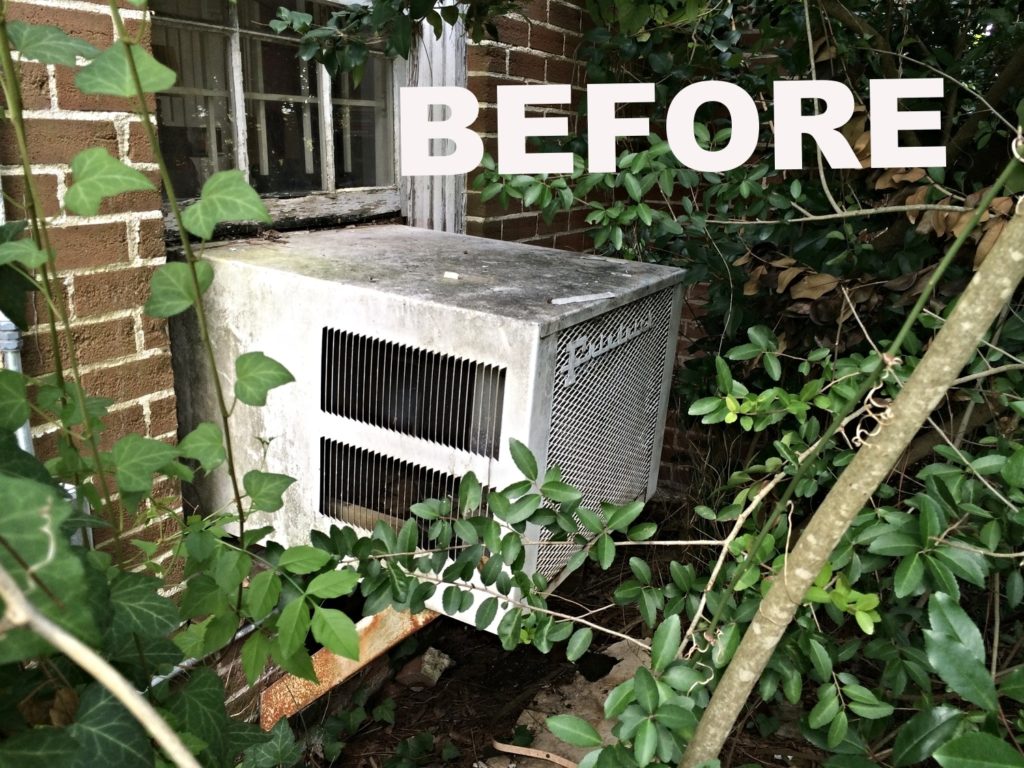
Check out the window unit being used before we installed a mini-split system below.
The Mini-Split System
We installed an LG 17 SEER single zone inverter unit. It’s a 24,000 BTU system with two tons of cooling power. This particular mini-split is also capable of heating the room when run in a reverse cycle. It operates on 208/230 electrical to the outdoor unit. The maximum noise level when the fan speed is on high is 45 decibels, and it drops down to a very quiet 35 decibels at low speed. The dimensions are 40 inches wide, 12 inches tall and 9 inches deep.
Take a look at the images below to see what goes into a ductless AC installation.



Observations From the Installation
Proper Tools Are Key
The walls of a home like this are solid. There’s no sheetrock or insulation here, just a solid wall with brick, plaster and heavy wire. To get through this, we had to go through several batteries on our tools. In the end, the hole was sufficient and still provided a very solid look.
Appropriate Covering is Essential
Aesthetics are important on homes like this. We had originally planned on routing the line set and cover on the exterior of the home from right to left. Instead, we were able to route directly down and underneath the house to the condensing unit because the home is a pier-and-beam structure. This allowed for a more streamlined and minimal look with the copper line set ducting making one line before terminating at the base of the brick (see pictures above).
Be Ready for the Unexpected
You might be wonder what the little hose going underground at the bottom of the line set is. We used a non-kinking flexible drain line to route condensation from the system (this is natural and required) instead of using PVC. This allows for the condensation to be routed more easily. The drain line here leads underground to a French drain.
If you need ductless installation in Houston, count on Mission AC to get it done. Contact us today to speak to one of our experts and begin a service request.
Need help with this at your home? Our licensed, background-checked techs give you an upfront price before any work starts.